Showing posts with label evaluate. Show all posts

Monday, April 11, 2011

Genocide Awareness Week


This week at my school the STAND (Students Taking Action Now in Darfur) group hosts Genocide Awareness Week. We build a model refugee camp and give tours of it the whole week. On Friday, we give presentations about historical genocides to classes and that night we have a musical fundraiser event. Events still occur in Darfur often, however, it is very rarely in the news.

Recently, I attended a talk at the Illinois Holocaust Museum given by Rebecca Hamilton, author of Fighting For Darfur, a story of activism and journalism surrounding the genocide in Darfur. She followed the spotlight of international attention in Sudan and Africa and found that when eyes are concentrated in one spot other conflict in other areas falls through the cracks. Once attention shifts, the attention-lacking areas are redefined but there are always places where events take place that warrant outcry and action, but do not receive it. The sad thing is that even when there is an outcry of a large group of people, as there was in the United States when the events in Darfur came to light, it does not guarantee any action or any wrongs being righted. Hamilton made the argument that if the attention does not shift, and if we can unite the stories of the different people of Sudan, then less crises and atrocities will slip through the cracks. So how can the story of Sudan be unified in a way that leaves nothing in the dark but brings into attention what needs to be done?

The two 'big' stories in Sudan recently were the referendum for Southern Sudan to secede and the Darfuri Genocide. As attention switched from one event to the other, people would be killed in Darfur or election preparations would be left undone in Southern Sudan, so both locations suffered. Uniting the narrative of the Southern Sudanese and the Darfuri people would have prevented, or at least helped to spread awareness about, some negative events.

Now, with the events happening throughout North Africa and the Middle East, Sudan might as well have fallen off the earth. Because 2 million people are still displaced from the conflict in Darfur, because more are joining their numbers every day, and because Darfur is not the only place that houses refugees and conflict is, why we host Genocide Awareness Week. To unite the stories of many into something that is consumable to the public may sound overly consumerist, however, in a fast paced world it is disgraceful that our outcry and our action is still slow. Our goal should be to find the balance between depth and scope of information so that the first story on the news is not the only crisis that we address.

So this week, remember those throughout the world that need remembering - and do what you can to act.

Monday, February 28, 2011

Hamlet - A Double Edged Soliloquy

Hamlet – the myth, the legend, the book I am reading in English Class. In almost everyone’s educational career they must read Hamlet (at least once) and contemplate the many layers of meaning it contains. It is one of the most prolific pieces of literature in the English language, as well as the most preformed play in the world (above is the famous image of Hamlet with the skull from the 1948 Hamlet film starring Sir Lawrence Olivier as Hamlet). There are many different critical approaches that can be used to examine and interpret Hamlet. In an attempt to keep this a post and not a novel, I will examine the soliloquy at the end of Act 4 Scene 4 (lines 33-69) from a formalist and a mythic approach, and then examine each approach itself.

From a Formalist perspective, the movement in this passage from logic to violence and perhaps madness is one worth examining. Throughout the soliloquy, Hamlet continues in iambic pentameter and keeps up metaphors including sleep as death and inaction and cowardice in life as living as a beast. There is also the parallelism between Hamlet and Prince Fortinbras, comparing the action coupled with purpose in Fortinbras with the actionless purpose of Hamlet. All of these structural ornaments show that Hamlet is at this point thinking intelligently and thoughtfully, however, as he finishes and with apparent logic concludes that, "from this time forth/My thoughts be bloody or be nothing worth!" (4.4.68-69), it is unclear as to whether he has crossed the line of sanity into madness. When this logical thought progression with all the ornamentation and appearance of a sane person in the play transforms near the end of the soliloquy into a conclusion that many people would consider not logical or sane, Shakespeare makes us question both what it is to be sane and insane, and what that might look like.

From a Mythical perspective, Hamlet throughout the soliloquy examines what it is to exist and to be human. Hamlet asks near the beginning of the soliloquy, "What is a man/If his chief good and market of his time/Be but to sleep and feed? A beast, no more./Sure He that made us with such large discourse,/Looking before and after, gave us not/That capability and godlike reason/to fust in us unused." (4.4.35-41). Hamlet examines the meaning in his life by comparing it to the life of a beast, where one only sleeps and eats and has no meaning. He states that, "I do not know/Why yet I live to say 'This things to do,' " and by that Hamlet concludes that being alive without fulfilling his purpose is not really living at all (4.4.46-47). Then, with the parallelism of Fortinbras fulfilling his purpose even if it puts his life at risk while Hamlet does not do this, Hamlet's thoughts of the relationship between purpose and real life are cemented. When Hamlet ends with "from this time forth/My thoughts be bloody or be nothing worth!" he shows his determination to fulfill his violent purpose in life because living is about fulfilling purpose rather than just staying alive (4.4.68-69).

With these two perspectives two different parts of the soliloquy can be excavated; but neither is more right than the other. Using only one would be sufficient, but Shakespeare deserves more! Both approaches, and others I did not use, unveil another layer of meaning in each part of Hamlet, so using them all in conjunction can warrant the most fulfilling reading of Hamlet. I am not sure if I even believed that before examining this passage with different approaches, but I definitely do now!

Well, that is my two cents. Let me know what you think!

Thursday, January 27, 2011

What's in (Southern Sudan's) Name?

Sudan election: Polling officials count ballots in Juba as polls closed
In Southern Sudan, from January 9th to 15th, a referendum was held to decide if Southern Sudan would secede from Northern Sudan. As of January 23, 2011, the preliminary results indicate that 98.8% of the voters voted for independence (votes per region). The result of the referendum will be declared, at the latest, on February 14, 2011. There were delays and problems in the preparations for the election, however, the elections went over with very few problems, and the African Union said that the referendum was "free, fair, and credible". This referendum comes after years of war between the north and the south. They gained independence from Great Britain and Egypt in 1956. A civil war began even before they gained full independence and lasted from 1955-1972, and a the second civil war began in 1983 and finally ended in 2005 with a peace agreement that promised this referendum. Over 2 million people have died in this conflict. Beyond the history lesson though, when Southern Sudan secedes (if everything goes as expected) they will face the question: What do we call ourselves now?

The name Sudan originally comes from the Arabic phrase bilad al-sudan (land of the blacks) which was used to describe Sub-Saharan Africa. So, the name Sudan does not have historical significance to the people of Southern Sudan any more than Native Americans have an affinity to the label 'Indian'. However, the Southern Sudanese people have grown up and struggled under the name of Sudan, they have developed an identity of the Sudanese people so to give that name up may be to forget all the struggle it took to finally gain independence. In the Sudan Tribune there have already been many articles about the possibilities of new names and arguments to keep the name Sudan. The leading contenders right now are South Sudan and The Nile Republic, as well as some other more creative and strange ideas (like Wunjubacel - a name made up of the first letter of the 10 southern Sudanese state names plus Abeyi, Nuba Moutains, and Blue Nile). Find arguments for South Sudan here, The Nile Republic here, and Wunjubacel here. Both the article for Southern Sudan and the article for The Nile Republic make valid points about each name. The name Southern Sudan helps the history of the country and the struggle towards independence apparent, and honors those that have perished to fight for it. While the name The Nile Republic gives the region its own separate identity and allows them to move forward. The Democratic Republic of the Congo (previously Zaire and the Belgian Congo) have had many names and with each one came different baggage. The name was changed to Zaire in 1965 partly in order to move past the dark ages of the Belgian Congo. However, under the name of the Congo the Congolese had developed their own identity, grown as a country, and in Zaire they found themselves living in a home that felt very different to the one that they remembered. I am not saying that if the South does secede they will be governed like President Mobutu governed Zaire, but I think it is an interesting parallel to draw. To what extent does what we call our home change us?

Beyond that, I think that Southern Sudan should decide on a name that is best for their future. Moving forward however, should be done while remembering the past. So, when they do decide what they will call themselves, be it Southern Sudan or the Nile Republic (or anything else for that matter), they should choose a name that represents them as a people - united, strong, and hopeful.

What do you think?

Tuesday, December 7, 2010

Equality v. Inequality


Yesterday I was reading Muslimah Media Watch (a blog dedicated to keeping track of how Muslim women are portrayed in the media with more than 20 contributors) and in this blog post Krista made a distinction that I think deserves a lot more attention. She wrote in reference to Bill 94 (a bill currently proposed in the province of Quebec, Canada to ban the niqab in any place of public service):
One issue that came up...was the difference between formal equality (everyone being treated in exactly the same way) and substantive equality (a more equity-focused concept, in which it is recognized that identical treatment doesn’t necessarily have egalitarian results). The argument here is that, while Bill 94 claims to treat everyone equally by requiring all people to show their faces, the result will have disproportionately negative effects on women for whom showing their faces in certain situations is just not an option; Bill 94, in other words, represents formal equality but will result in substantive inequality.
So, what is equality? If Bill 94 is passed, and it will not be the first of it it's kind if it is. It will not have an effect on everyone. When it comes down to it, it will only have an effect, a negative effect, on the small sect of the population that wears the niqab. That is, both mathematically and morally, the bill is unequal. If every single person wore the niqab, and it was banned, only then would this bill be substantively equal. However, only then would there be more of an outcry, if only because there would be numbers behind the plea.

This episode begs the question, can the government make every law they pass equal in its effects? Harrison Bergeron by Kurt Vonnegut Jr. teaches us that it cannot. If everyone is brought down to the same level, we could be all equal (and affected equally by every law), but then the beauty of the human race would be lost. People are born unequal. That is how the world works.

However, coming back to Bill 94, how close can we get to equality before we cross over the line and make the world more unequal, even if it is only for a select few? Considering the differences between ' formal equally' (in its most extreme version in Harrison Bergeron) and 'substantive equality' must be a requirement. Equality is a word that is thrown around a lot, but true equality would be the kind where everyone was affected the same way. Those who proposed Bill 94 do not (I hope) have any hatred for people who wear that niqab, but I think policy makers have to be aware that they can easily be pulled into the recent wave of Islamaphobia and to remember that fear does not give grounds to effectively deny any human being their rights. I do not wear a niqab, and I do not know anyone personally who does, but still I am offended by this regression to inequality among people who live in the same neighborhood. I hope that the supporters of Bill 94, and other bills like it, stop to think about how to balance safety concern with equality.

Monday, November 15, 2010

Smear Your Competition?


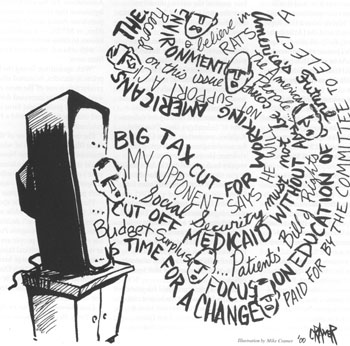
I follow Culture Clash (a blog written by a multicultural Canadian-American), and the other day I was reading her post about the recent election and specifically the ad campaigns that occurred before election day. I started to write a comment, but I liked the topic so much I wanted to dedicate more time to it.

I too have gotten sick of the attack ads during this campaign season. As Stephanie mentioned, Wesleyan University recently published a study showing that ads based on personal characteristics of political components have increased by 6 percent since the 2008 election. I am not surprised, it seems to get worse with every election. In comparison, other countries have a distinct abhorrence to smear ads and the inevitable lies and slander that go along with them. In the recent England elections, two judges ordered a re-election for a seat of Parliament in northern England because the winning representative was found to have publicized false statements about his opponent. The statements that the liberal democrat courted Muslim militants who had advocated violence against the Labour Party candidate seem all too familiar. I would say that there have been even worse campaigns in the United States, and they will inevitably grow worse next election. Politifact (a non-partisan group that checks facts during elections) found in a recent study that most of the ads during this campaign season where barley true. They twisted facts wherever possible, and outright lied on occasion, but the damage has been done.

These ads do only sully the run-up to the election though, a lot more is at stake. This competitive and utterly poisonous atmosphere can continue after the elections, making bi-partisanship near impossible. I think the question here is what do we do to stop the vicious cycle? I think publicizing things like Frank Luntz's recent study about campaign ads would be a good start. He found that talking straight and not trivializing the issues makes the best campaign ad, not smearing your competition. Perhaps these negative campaign ads do help the party publishing them by a few percentage points, but I think the trade-off for American democracy is much worse. It worries me that here, in what we hope is the most democratic nation in the world, people are continuing to fall back on dirty campaigns rather than speaking about the issues that matter. They should be talking about the real things that people should election them for, not the trivial false statements that are taking up more and more of our time and money each year. We need to consider our combative ideas when it is election time for not only the benefit of the next two years but for the future of American democracy.

What do you think?